Kitchen Pricing Breakdown
India's modular kitchen market was valued at USD 3.62 billion in 2025 and is projected to reach USD 4.86 billion by 2034, according to a 2025 market report by the IMARC Group. Almost none of that money is spent against a quote the buyer could actually read. Most homeowners in 2026 are not overpaying because rates are high, they are overpaying because two quotes with the same bottom line can describe two entirely different kitchens.
What are you actually paying for in a modular kitchen quote?
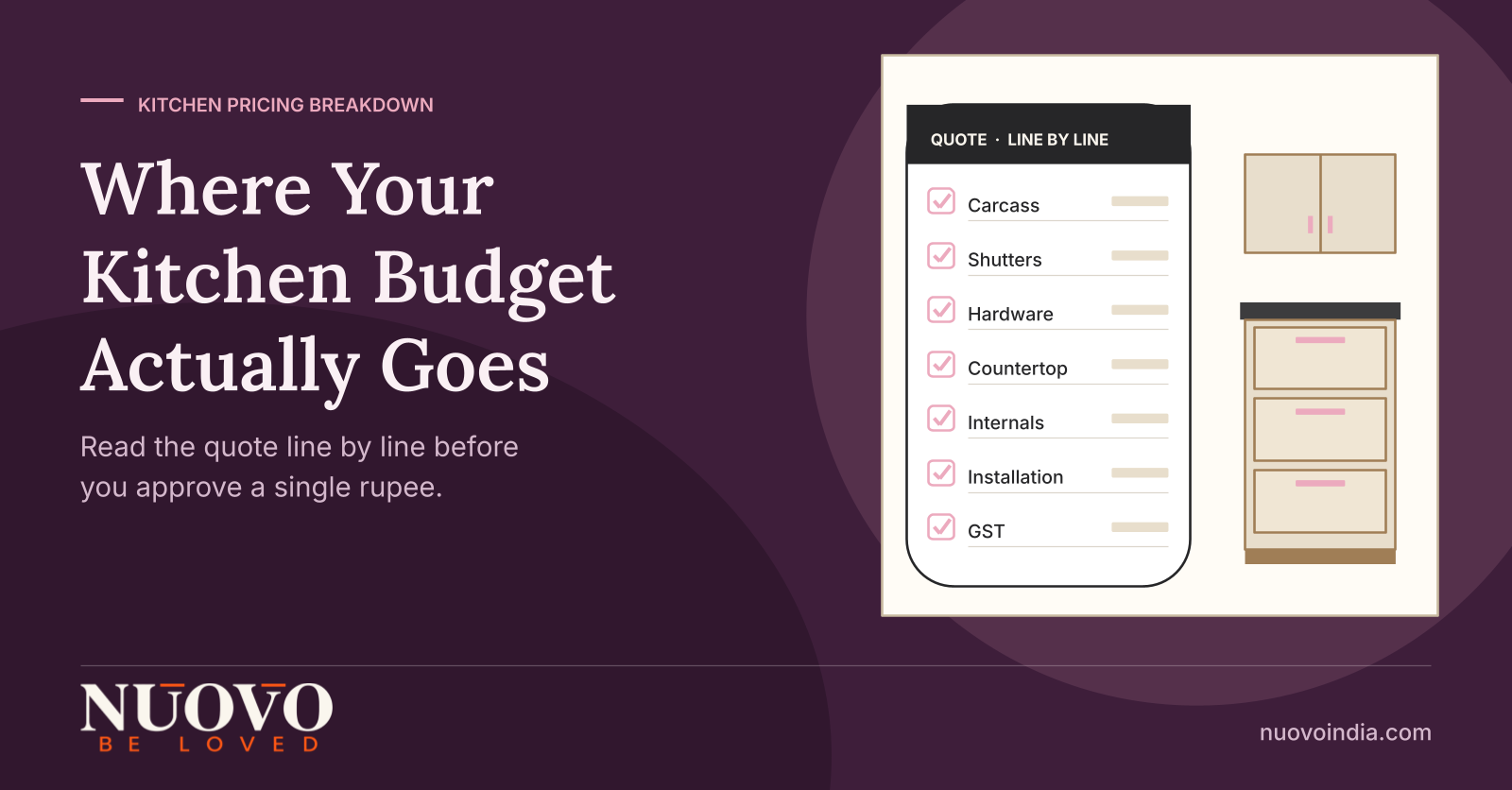
A modular kitchen quote is paying for five separate things, and most quotes blur them together. Those five are the carcass (the boxes that form the cabinets), the shutters and finish you see from outside, the hardware that makes drawers and doors move, the countertop and backsplash, and the labour plus design and installation that holds it all together. On top of that sits Goods and Services Tax.
Price differences between vendors almost always trace to a specific swap inside one of these five buckets, not to a general difference in quality. Once a quote separates them, comparison becomes arithmetic instead of guesswork.
What do the key pricing terms mean?
Five terms carry almost all the meaning in a kitchen quote: carcass, shutter, hardware, countertop and bill of quantities. Getting precise about these five is the fastest route to a price you can actually compare.
- Carcass: the structural box of each kitchen cabinet, usually in plywood or an engineered board such as medium-density fibreboard. It is hidden, so it is the easiest place to quietly reduce cost.
- Shutter: the visible front, plus its finish (laminate, acrylic, membrane, lacquered glass, veneer). This is where most of the aesthetic budget lives.
- Hardware: hinges, drawer channels, lift systems, baskets and handles. It is the part you touch twenty times a day.
- Countertop: the working surface, typically granite, quartz or a solid surface material. See the general overview of countertop materials for how these families differ.
- Bill of quantities: an itemised list of every unit, its size, its specification and its rate. In construction this document is standard practice, and a bill of quantities is exactly what a kitchen quote should look like.
If a quote gives you a single number for "modular kitchen" with a running-foot rate attached, it is a price, not a specification. A price you cannot take apart is a price you cannot compare.
Why do kitchen budgets overshoot so often?
Budgets overshoot mainly because of decisions made after the budget was set, not because of the original estimate. The data on this is consistent and unflattering.
- In the 2026 U.S. Houzz & Home Study, 37 percent of homeowners who renovated in 2025 exceeded their budget, while only 35 percent landed on target.
- The same 2026 study found that 35 percent of renovating homeowners consciously selected higher-end materials than they had planned, and 31 percent expanded the project scope mid-renovation.
- In an earlier Houzz survey of 70,000 homeowners who renovated in 2015, reported by Houzz in July 2016, only 3 percent came in under budget, and close to half of those who went over blamed upgrading to more upscale products and finishes.
- Closer to home, a 2016 study by Swapnil P Wanjari and Gaurav Dobariya in Sadhana, the journal of the Indian Academy of Sciences, ranked price escalation of raw materials as the single biggest cost overrun factor in Indian construction projects, agreed on by 67 percent of respondents, followed by delay in planned activity at 48 percent and lack of coordination between parties at 46 percent.
Read those four findings together and a pattern appears. The overrun is rarely a pricing error. It is a decision that was still open when work began.
Why does the same kitchen get three very different quotes?
Because the three vendors are not quoting the same kitchen. They are quoting three different sets of assumptions about everything you did not specify, and the cheapest quote is usually the one that assumed the least.
The most common gap is the running-foot rate. A rate per running foot of base and wall unit says nothing about carcass board grade, hinge and channel brand, number of drawers versus shelves, tall unit count, corner solutions, or whether the countertop, sink, chimney, hob, electrical points, plumbing shifts and loose fillers are in or out.
The second gap is who owns the gaps. Civil work, electrical repositioning, waterproofing under the sink, skirting and final touch-up are small lines individually and a meaningful sum collectively, and they appear on a quote only when someone has taken responsibility for them.
The third shift is structural. Mordor Intelligence reported in its 2026 India modular kitchen analysis that the developer and project channel rose to 35 percent of organised volumes in 2026 from 24 percent a year earlier, which means more buyers now inherit a partly fitted kitchen and quote only the delta. Comparing a full-scope quote against a delta quote is the single easiest way to misjudge cost.
It helps to remember what the spend is for. "They're no longer just functional spaces but areas where families gather, cook and spend quality time," said Andre Eckholt, Managing Director of Hettich India, in an interview with Elle Decor India. A kitchen that carries that much daily load is worth specifying properly.
Where does the money actually go inside a kitchen?
Money concentrates in four places: the finish you see, the hardware you operate, the countertop you work on, and the board you never see. The table below shows what moves cost inside each one and the question that makes a vendor commit to an answer.
|
Cost component |
What actually drives the cost |
Ask this before approving |
What a vague answer usually hides
|
|---|---|---|---|
|
Carcass board |
Board type and grade, core density, moisture resistance, edge banding quality |
Which board, which grade, and which standard does it certify to? |
A lower grade board in wet zones under the sink and hob |
|
Shutters and finish |
Finish family (laminate, membrane, acrylic, glass, veneer), edge treatment, number of profiles |
Is the finish quoted per shutter or averaged across the kitchen? |
Premium finish shown in renders, standard finish in the rate |
|
Hardware |
Hinge and channel brand and series, soft close, load rating, lift and corner mechanisms |
Brand plus model number for every hinge, channel and lift unit |
Brand named once, entry series fitted throughout |
|
Countertop and backsplash |
Material, thickness, edge profile, cut-outs for sink and hob, backsplash height |
Is the countertop, its cut-outs and the backsplash inside this number? |
Countertop excluded, surfacing it later as an unavoidable extra |
|
Accessories and internals |
Drawer count versus shelf count, cutlery and pull-out baskets, waste bins, corner units |
How many drawers, and which internals are included by unit? |
Shelves priced where drawers were promised |
|
Labour, design and installation |
Site measurement, design iterations, dismantling, installation crew, post-installation rectification |
Is installation and post-installation rectification in scope? |
Installation billed separately after the kitchen is manufactured |
|
Allied civil and services |
Electrical points, plumbing shifts, waterproofing, chimney ducting, false ceiling cut-outs |
Who executes and pays for these, and against which line? |
The entire category left for the homeowner to arrange |
How does GST change what you pay?
Modular kitchen furniture attracts 18 percent GST in India, and whether a quote shows it or hides it changes your effective comparison by nearly a fifth. Furniture under HSN heading 9403 is taxed at 18 percent, as is plywood and laminated wood under 4412, particle board under 4410 and fibre board under 4411, per ClearTax's 2026 guide to GST on furniture and raw materials, which also notes that the September 2025 revision lowered rates for certain eco-friendly boards while standard engineered wood products stayed at 18 percent.
The practical consequence is simple. Always compare quotes on the same side of tax, either all inclusive or all exclusive, because an exclusive quote beside an inclusive one looks cheaper without being cheaper. Background on how the Goods and Services Tax system applies rate slabs to goods is useful context if you want to read your invoice closely.
One more thing worth asking in 2026: is the quote from a GST registered entity, and will you receive a tax invoice? That single document is what makes a later service claim or dispute enforceable.
What should you judge a kitchen partner on instead of the headline number?
Judge on the quality of the specification, not the size of the discount. Four criteria separate a partner who will hold the number from one who will revise it.
- Specification discipline: every unit listed with size, board, finish, hardware model and rate. A vendor who writes this down before taking money has already decided not to surprise you.
- Storage and layout thinking: whether the design starts from what you store and how you cook, or from a standard set of modules fitted to your wall length. The first approach reduces cost by removing units you do not need.
- Material and hardware honesty: named grades and model numbers rather than category words like "branded" or "imported". Specificity is the cheapest form of accountability.
- Single point execution accountability: one party responsible for manufacturing consistency, site readiness, installation and rectification. Split responsibility is where both delays and extra bills are born.
What should you check before you approve a kitchen quote?
Check six things, and do it before any payment, because every one of them gets more expensive to change after manufacturing starts.
- A unit-wise bill of quantities, not a running-foot rate. Each cabinet should have its own line, size and specification.
- Inclusions and exclusions written as two separate lists. The exclusion list is the more informative of the two.
- Hardware named to model level, with soft close and load rating stated for drawers you will load heavily.
- Finish samples seen physically in daylight, alongside the actual board edge, not only in a rendered 3D view.
- A written change order rule: what a mid-project change costs, and how it affects the schedule, agreed before you need it.
- A decision freeze date, after which the design is locked. Keep a contingency of 10 to 15 percent of whatever your own number is, so on a ?10 lakh interiors budget that is ?1 lakh to ?1.5 lakh held back deliberately.
That last point is the one professionals repeat most. "If you haven't picked them out, invariably it will be more money. Two, it will take more time," said Anne Higuera, co-owner of Ventana Construction in Seattle, speaking to Houzz about unselected materials and fittings.
Who can turn a specified kitchen into an installed one?
A single team that owns design, manufacturing and installation together is what keeps an approved price intact, because there is no boundary for scope to fall through.
Nuovo Kitchens and Wardrobes works as a design-to-execution partner for modular kitchens and wardrobes, taking a residential project from storage planning and layout through material and hardware selection to manufacturing and professional installation. Working with homeowners, architects and interior designers on new homes, renovations, apartments and villas, the team's focus is on specifying a kitchen precisely enough that the number you approve is the number you live with.
If you are at the stage of comparing quotes, the most useful next step is to look at finished work and ask specification-level questions about it. You can browse Nuovo's modular kitchen and wardrobe work and then talk through your own kitchen or wardrobe requirement with the Nuovo team, bringing your floor plan and your storage list so the conversation starts with your layout rather than a rate card.
Frequently asked questions
Why do vendors quote per running foot if it is not comparable?
Running-foot pricing is quick to produce and easy to discount, which makes it useful for a first conversation and unreliable for a decision. It averages cost across units that cost very different amounts to build, so a kitchen heavy on drawers and tall units is underpriced and a simple one is overpriced. Ask for the same kitchen as a unit-wise bill of quantities before you compare anything.
Should I budget for the countertop separately?
Only if your quote excludes it, and you should confirm that in writing rather than assume either way. Countertops vary widely by material, thickness and edge profile, and cut-outs for the sink and hob are sometimes billed separately again. Treat the countertop, its cut-outs and the backsplash as one line item and get all three priced together.
How much contingency should I keep for a kitchen project?
A buffer of 10 to 15 percent of your own total number is a widely used planning range, and the Houzz data on scope expansion suggests it is realistic rather than cautious. In the 2026 U.S. Houzz & Home Study, 31 percent of renovating homeowners expanded scope mid-project. Keeping the buffer separate from the main budget is what stops a change from becoming a compromise elsewhere.
Is a cheaper quote always a lower specification?
Not always, but it is almost always a different specification, and the difference is usually in the carcass board, the hardware series or the scope of allied civil work. Put the two quotes side by side at unit level and the gap will reveal itself in three or four specific lines. If a vendor cannot show you those lines, the saving is unverifiable.
Does GST apply differently if the kitchen is made on site?
Tax treatment depends on how the supply is structured and invoiced, which is a question for your vendor and, for anything material, for a qualified tax advisor. What matters for comparison is that you see the GST component stated explicitly on every quote you are weighing. Nuovo's frequently asked questions on kitchens and materials are a useful starting point for the specification side of the same conversation.
When should the design be frozen?
Before manufacturing begins, and ideally before the first payment milestone tied to production. Once panels are cut to size, a layout change stops being a drawing revision and becomes new material. A firm freeze date, agreed in writing, is the cheapest schedule protection available to a homeowner.
Sources
- IMARC Group, India Modular Kitchen Market Report, Size and Outlook (2025)
- Houzz, 2026 U.S. Houzz & Home Study: Renovation Trends
- Erin Carlyle, "From the Pros: 8 Reasons Kitchen Renovations Go Over Budget", Houzz, July 2016
- Swapnil P Wanjari and Gaurav Dobariya, "Identifying factors causing cost overrun of the construction projects in India", Sadhana, Indian Academy of Sciences (2016)
- Mordor Intelligence, India Modular Kitchen Market Report, Size, Outlook (2026)
- ClearTax, GST on Furniture and Raw Materials 2026: Updated Rates and HSN Code
- Elle Decor India, "5 Questions with Andre Eckholt, Managing Director of Hettich India"
- Wikipedia, Bill of quantities
- Wikipedia, Kitchen cabinet
- Wikipedia, Medium-density fibreboard
- Wikipedia, Countertop
- Wikipedia, Goods and Services Tax (India)
-
How good quality furniture can improve overall efficiency

-
Increase productivity with use of good quality office furniture.

-
Your Comfort is our first priority.

-
Benefits of modular kitchen

-
Advantages of Modular Kitchens over traditional Kitchens

-
10 Tips for Planning the Perfect Modular Kitchen

-
How to Choose the Right Office Chair for Your Needs

-
How to Care for and Maintain Your Modular Kitchen

-
The Role of Color in Office Furniture

-
How do you set a table for dinner?