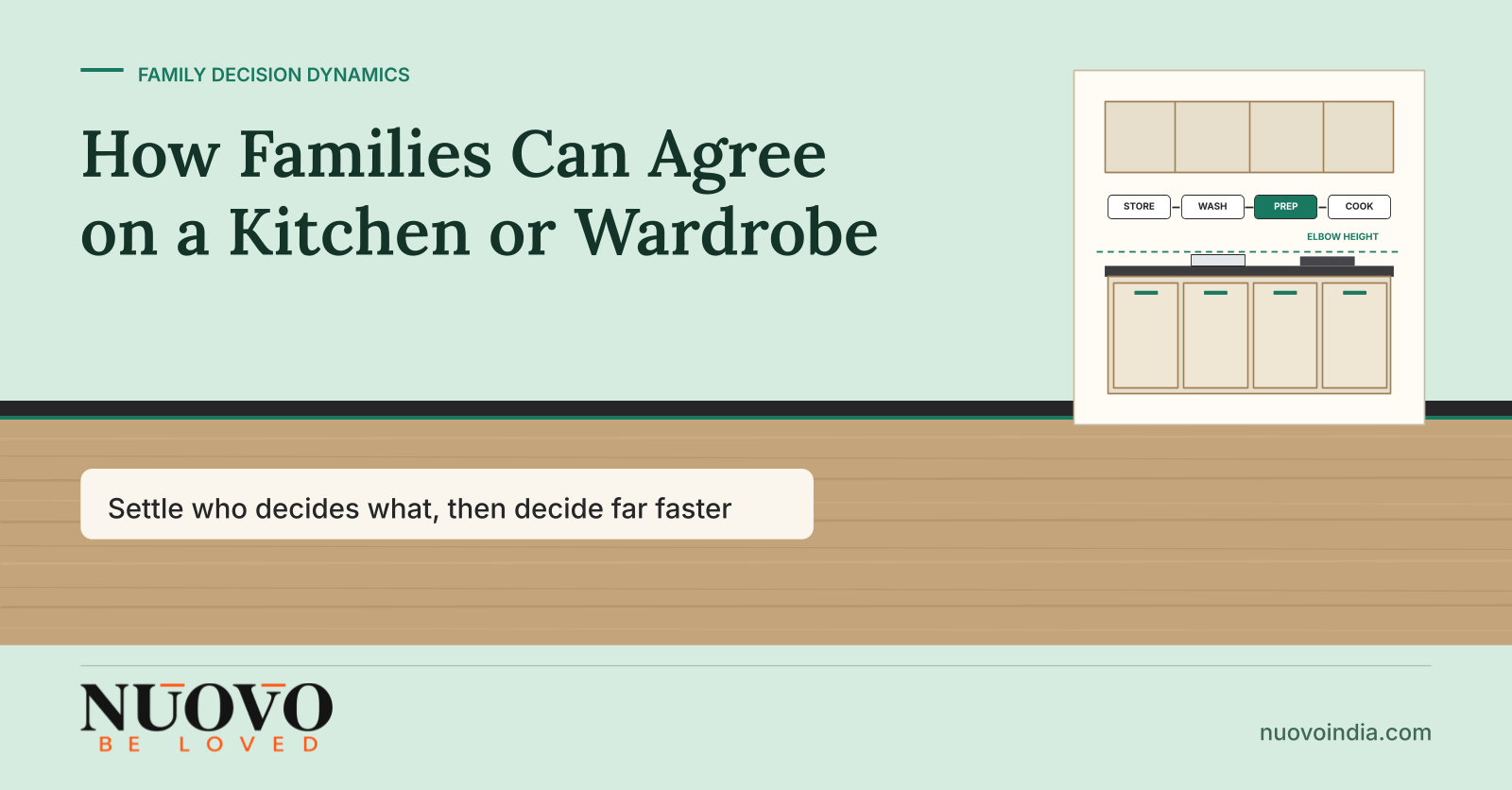
How Families Can Agree on a Kitchen or Wardrobe Without Months of Back and Forth
Most Indian households plan a kitchen about as often as they change cars. According to Alvarez & Marsal's May 2025 analysis of India's home improvement market,the category is worth roughly ?3 lakh crore, is growing at 9 to 10 percent a year, and is expected to reach ?4 lakh crore by 2030, with homeowners renovating every 10 to 12 years.
So a decision that shapes ten years of daily cooking and dressing is usually taken by three or four family members with no recent practice at taking it together.
What is the fastest way for a family to agree on a kitchen or wardrobe?
Assign decision rights before you discuss designs. Name one final decision maker for the project, agree who must be consulted on layout, storage, materials, hardware and finish, and write down what each person actually needs from the space.
Settle the budget range and the non-negotiables first, then review design options together in one sitting rather than across weeks of forwarded images. Freeze the design before manufacturing begins, because changes after that point cost both time and money. Families who work this way decide faster, argue less, and end up with a space that suits everyone who uses it daily.
What does family decision dynamics mean in a kitchen or wardrobe project?
Family decision dynamics is simply the pattern of who proposes, who objects, who pays and who finally approves in a home project. In a modular kitchen or wardrobe project, that pattern decides your timeline far more than the factory does.
Two terms are worth defining early. A final decision maker is the single person who closes an open question when the family is split, which is not the same as the person paying. Scope creep, a term borrowed from project management, describes the uncontrolled growth of a project after it has started, and it is what late additions quietly become.
A third idea matters for kitchens specifically. The kitchen work triangle is a planning concept that positions storage, washing and cooking so that daily movement stays short, and it is often the first thing sacrificed when a family designs by consensus on aesthetics alone.
Why do kitchen and wardrobe decisions stall when more people are involved?
They stall because the family is debating product choices before anyone has agreed on scope, budget and authority. The data shows the same three pressure points again and again.
In the 2025 U.S. Houzz Remodeling and Relationships Report, which surveyed more than 540 couples who had renovated in the previous year, the most common sources of disagreement were staying on budget (31 percent), deciding on products, materials or finishes (28 percent), and agreeing on the project's scope or design (20 percent). The same 2025 report found that 4 percent of couples considered separating during a renovation, rising to 12 percent among couples together five years or less.
The strain is real, and it is mostly a coordination failure rather than a taste failure.
"A home renovation is one of the most demanding journeys a couple embarks on together," said Marine Sargsyan, staff economist at Houzz, discussing the 2025 findings in Forbes. She added that "many respondents report a desire for improved visibility and coordination during a project."
Indian homes add a further layer, because the decision is rarely a couple's alone. The Godrej Interio Index, released in October 2018, found that 52 percent of Indian households decide home furnishing questions collectively, while the male head of the household has the final say in 24.9 percent of homes and the female homemaker in 23.1 percent.
For the kitchen specifically, that study reported that women had the final word in 38.1 percent of homes and men in 17.1 percent, with 44.8 percent of kitchen decisions taken collectively.
"Today, the home space is no longer the exclusive domain of the women of the house," said Anil Mathur, Chief Operating Officer at Godrej Interio, in the study's 2018 release.
In other words, nearly half of kitchen decisions in India are taken by a group. Groups are good at setting direction and poor at closing questions, which is exactly where projects lose weeks.
Who should have the final say on which decisions?
Split the project by who lives with the consequence. The person who cooks daily should hold layout and storage, the people paying should hold budget and scope, and technical calls should sit with the designer rather than with whoever has the strongest opinion.
The table below is a starting structure that families can adapt in one conversation, before any drawing is produced.
|
Decision area |
Who should decide |
Who should advise |
Why it belongs there
|
|---|---|---|---|
|
Kitchen layout and work zones |
Primary daily cook |
Designer, other cooks in the family |
Daily movement and fatigue are paid for by one person, not by the committee |
|
Storage allocation and wardrobe sections |
Each user, for their own zone |
Designer |
Storage only works when it is mapped to what is actually owned |
|
Core materials and carcass specification |
Designer, confirmed by payer |
Family |
Moisture behaviour and load bearing are technical, not aesthetic, questions |
|
Hardware (hinges, channels, lift systems) |
Designer, confirmed by payer |
Daily users |
Most early failures trace to hardware choice and installation, not to shutter looks |
|
Finishes, colours and handles |
Family, collectively |
Designer |
This is the one layer where taste genuinely should win |
|
Budget, scope and change approvals |
Single named decision maker |
Family |
Shared budget authority is the most reliable way to miss a budget |
Notice what this does. It moves the family's energy to the finish layer, where disagreement is cheap, and away from the carcass and cabinetry layer, where disagreement is expensive and usually uninformed.
What has changed about how Indian families research these decisions?
Families now arrive with far more information and far more conflicting opinions than a decade ago. That raises expectations and, without structure, slows decisions down.
Alvarez & Marsal reported in 2025 that more than 60 percent of urban Indian consumers now consult digital sources before home improvement decisions, against about 25 percent five years earlier. The same 2025 analysis noted a 40 percent year on year rise in demand for customised interiors, smart home solutions and custom finishes.
More customisation means more open questions, and every open question needs an owner. This is why, in 2026, the bottleneck in most residential kitchen projects is decision speed rather than manufacturing capacity.
Professional involvement is already the norm. The Houzz & Home India Survey published in September 2019, covering more than 2,500 Indian respondents, found that 97 percent of renovating homeowners hired a professional, with kitchens the most commonly renovated room at 33 percent and a median renovation spend of ?3,00,000.
How do you stop late changes from derailing the project?
Set a decision freeze date and treat it as seriously as the payment schedule. Everything reversible before that date is free, and everything after it carries a cost in rework, material and time.
A workable sequence looks like this:
- Lock the layout and appliance positions first, because plumbing and electrical points follow them.
- Lock storage allocation next, section by section, against a written list of what goes where.
- Lock carcass material, edge banding and hardware before finishes, not after.
- Lock finishes, countertop and handles last, since these are the decisions families most enjoy revisiting.
- After the freeze, route every proposed change through the single named decision maker, in writing.
Put the freeze date in the quotation itself. A partner who resists doing so is telling you something useful about how changes will be handled later.
What should families look for in a design partner now?
Look for a partner who reduces the number of open decisions rather than one who multiplies options. The criteria below matter more than showroom size.
- Structured discovery. They ask who cooks, who stores what, and who approves, before showing a single design.
- Storage planning against a real inventory. They plan around your utensils, appliances and clothing categories, not around a standard cabinet set.
- Specification in writing. Carcass material, edge banding, hardware brand and model, and finish type appear in the quotation, with GST treatment stated clearly.
- Manufacturing consistency. Repeatable machine-made components reduce the variation that causes alignment and shutter-gap complaints later.
- Single-point accountability. One team owns design, manufacturing and installation, so coordination failures do not become your problem to referee.
What should you check before you sign?
Check for clarity, not for enthusiasm. These six checks separate a partner who has thought the project through from one who is quoting a cabinet rate.
- Does the quotation list hardware by brand and model, or only as "soft close"?
- Is every unit itemised with its material specification, so you can compare like with like across vendors?
- Is the scope boundary written down, including what is excluded (civil work, electrical shifting, appliance supply)?
- Is there a stated design freeze point and a written process for changes after it?
- Does the plan show reach zones and working heights for the people who will actually use the space daily?
- Is installation handled by the same accountable team that manufactured the units?
If a family can answer these six questions together, most of the arguing is already finished.
Who can hold the design and execution together?
Nuovo Kitchens & Wardrobes works with homeowners, architects and interior designers on modular kitchens and wardrobes for apartments, villas and independent homes, across new builds and renovations. The focus is on design thinking, storage planning, materials and hardware, quality manufacturing and professional installation, held together as one design-to-execution process rather than handed between parties.
For families, that single line of accountability is often what turns a stalled group conversation into a sequence of decisions that can actually be closed, which is the logic behind Nuovo's design-to-execution approach to kitchens and wardrobes.
If your family is at the stage of comparing layouts and specifications, the most useful next step is a focused conversation about how your household actually uses the space. Discuss your kitchen or wardrobe requirements with the Nuovo team and bring the storage list described above, because that single document settles more disagreements than any mood board.
Frequently asked questions
Who should be the final decision maker for a kitchen project?
Choose one person who can close open questions when the family is split, and say so out loud at the start. It does not have to be the person paying, and in many homes the primary cook is the better choice for layout and storage. What matters is that the role exists and everyone knows who holds it.
How do we handle disagreements between parents and children about design?
Separate technical decisions from taste decisions and allocate them differently. Layout, materials and hardware should follow daily use and expert advice, while colours, handles and finishes are a reasonable place for the family to compromise collectively. This narrows the argument to the layer where disagreement costs nothing.
What if we change our mind after the design is approved?
Expect a cost in time, material or both, depending on the stage. Changes before manufacturing are usually manageable, while changes after cutting has started mean rework. Ask your partner, in writing and before signing, exactly how post-freeze changes are priced and scheduled.
Should every family member visit the showroom?
Bring the people whose decisions you want closed that day, not everyone with an opinion. A visit works best when the primary user and the final decision maker are both present, because that combination can actually approve something. Wider family input is better gathered beforehand, in the storage and priority list.
How long should the decision stage take?
Plan for it to take longer than you expect and compress it deliberately. Timelines slip far more often from incomplete decisions than from production delays, so setting dates for layout approval, specification approval and finish approval is more effective than setting a single delivery date.
Does more customisation mean a better kitchen?
Not automatically, and sometimes the reverse. Customisation is valuable when it solves a documented habit, such as where your pressure cookers or your festival crockery actually live, and it adds cost and complexity when it is added for its own sake. Decide which habits you are solving before deciding how custom to go.
Sources
- Alvarez & Marsal, "India's Home Improvement Boom: From Repair To Reimagination" (May 2025)
- Jamie Gold, "New Survey Reveals How Remodeling Projects Can Hurt Your Relationship", Forbes (16 September 2025), reporting the 2025 U.S. Houzz Remodeling and Relationships Report
- Godrej Interio Index, PR Newswire India (22 October 2018)
- Houzz & Home India Survey, Houzz press release (18 September 2019)
-
How good quality furniture can improve overall efficiency

-
Increase productivity with use of good quality office furniture.

-
Your Comfort is our first priority.

-
Benefits of modular kitchen

-
Advantages of Modular Kitchens over traditional Kitchens

-
10 Tips for Planning the Perfect Modular Kitchen

-
How to Choose the Right Office Chair for Your Needs

-
How to Care for and Maintain Your Modular Kitchen

-
The Role of Color in Office Furniture

-
How do you set a table for dinner?

-
Kitchen Pricing Breakdown
-
How to Verify a Kitchen or Wardrobe Company's Real Work Before You Pay an Advance

-
Modular vs Carpenter Made Kitchens: Which Common Beliefs Actually Hold Up in 2026?

-
Kitchen Pricing Myths That Quietly Cost Indian Homeowners Money

-
Kitchen Workflow Myths: Why a New Kitchen Can Still Feel Tiring to Cook In