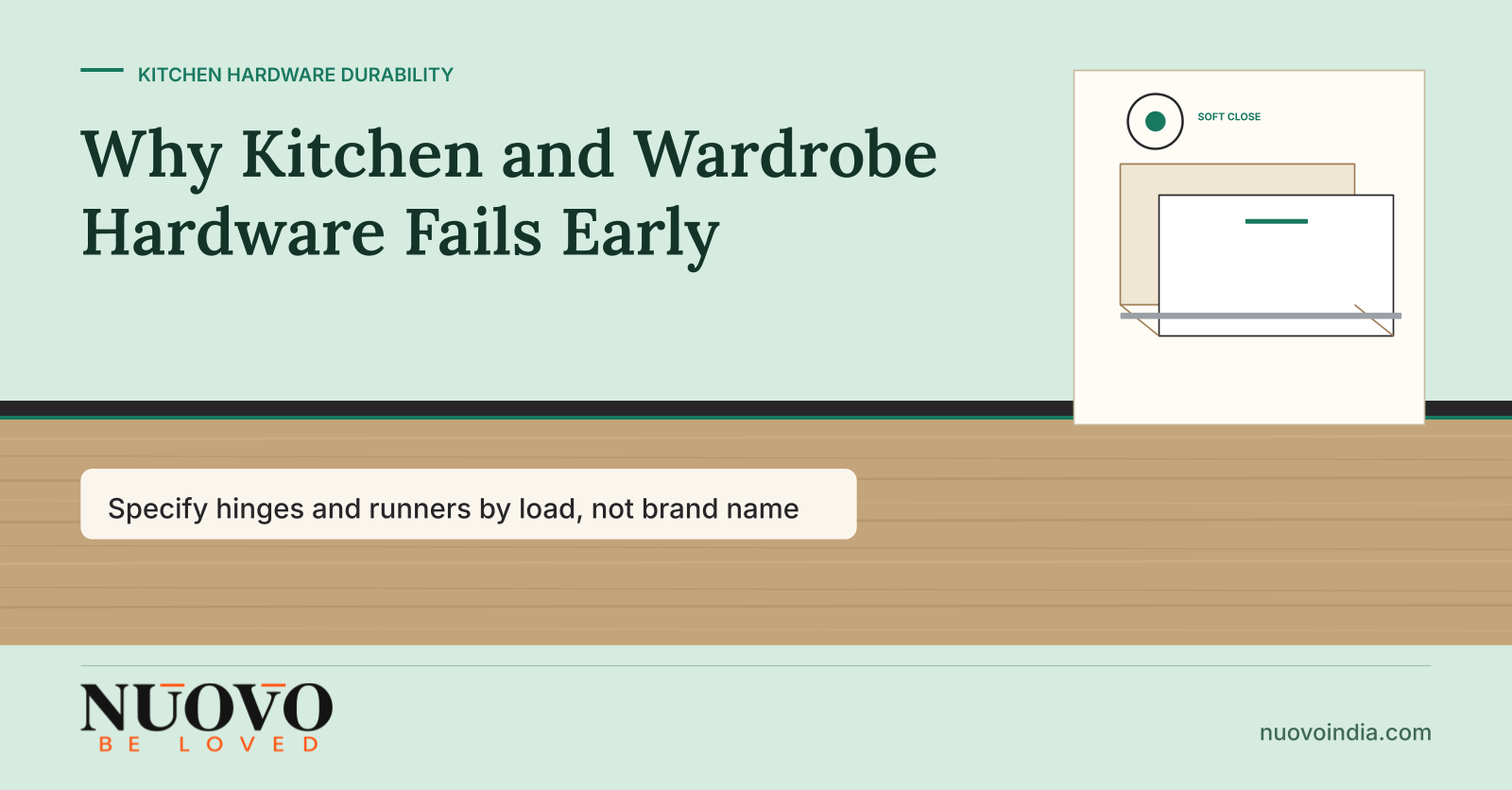
Why Kitchen and Wardrobe Hardware Fails Early, and How to Specify Hardware That Lasts
Hinges were the single largest product category in India's furniture hardware market in 2025, accounting for 26.88% of revenue, according to Mordor Intelligence. That is a lot of money spent on a component most homeowners never ask a single question about until a door starts dropping.
The short answer: why does kitchen and wardrobe hardware fail early?
Hardware usually fails early for three reasons, and none of them is the brand name on the box. First, it is matched to a price point rather than to the door weight, drawer load and daily opening frequency it will actually carry. Second, it is fixed into panels and carcasses that cannot hold a screw under repeated load, so the fixing fails before the mechanism does.
Third, it is never adjusted after the first few weeks of use, when doors settle and alignment drifts. Specifying by tested cycle life, load rating and fixing method prevents most of it.
What exactly counts as "hardware" in a modular kitchen or wardrobe?
Hardware is every moving or load-bearing metal component that makes a cabinet work, as opposed to the panels that make it look like something. In a modular kitchen and wardrobe specification it covers five groups.
- Hinges. Concealed cup hinges (also called Euro hinges) that carry shutter weight and set door alignment.
- Runners. Drawer runners, also called slides, which carry the loaded weight of a drawer and control how far and how smoothly it opens.
- Motion control. Soft close dampers, push to open latches, lift and fold-up fittings for overhead shutters.
- Internal systems. Pull-out baskets, tall unit frames, corner mechanisms, wardrobe trouser racks and pull-down rods.
- Fasteners and connectors. Cam locks, dowels, minifix connectors, wall hanging rails and the screws that hold all of the above into the carcass.
Two of these groups, hinges and runners, absorb almost all the daily movement in a kitchen. That is why they fail first, and why they are the right place to spend a disproportionate share of a hardware budget.
How often is hardware actually used, and why does that break things?
Hardware is tested in opening and closing cycles, and household use reaches those numbers faster than most buyers assume. The Italian furniture testing institute CATAS describes three durability levels for furniture hinges under the European standard EN 15570:2008, set at 20,000, 40,000 and 80,000 cycles.
Run the arithmetic on a single kitchen shutter. A door opened and closed ten times a day passes 20,000 cycles in roughly five and a half years, and 40,000 in about eleven. A cutlery drawer or a grocery pull-out in an Indian kitchen is opened far more often than that.
Three further data points explain why the risk lands on homes rather than offices.
- Residential end use accounted for 63.78% of India's furniture hardware sales in 2025, on the same Mordor Intelligence analysis. Domestic use is the least controlled environment hardware ever sees.
- The number of doors and drawers per home is rising. Average apartment sizes across India's top seven cities climbed 17% in two years, from 1,420 sq ft in 2023 to 1,676 sq ft in 2025, Business Standard reported in February 2026, citing data from property consultancy Anarock.
- Hardware is a growing share of what a kitchen costs to build. The India furniture fittings market was worth USD 473.4 million in 2025 and is projected by the IMARC Group to reach USD 1,116.2 million by 2034, a compound annual growth rate of 9.70%.
The cost of getting it wrong is rarely the hardware itself. It is the shutter that has to come off, the panel that has to be re-drilled or replaced, and the painting or stone work disturbed around it.
Why is early hardware failure becoming more common in Indian homes?
Because homes are getting larger and more heavily fitted while hardware decisions are still being made last and fastest. More storage means more mechanisms, and more mechanisms multiply any specification error across the whole house.
Anuj Puri, Chairman of the Anarock Group, told Business Standard in February 2026 that "Large 3 to 4 BHKs and homes with added study rooms have now become mainstream in many of the top seven cities." A four bedroom home carries several wardrobes, a utility area and a kitchen, which can mean well over a hundred hinges and runners in one project.
The supply side has noticed. Andreas Hettich, Chairman of the Hettich Group Advisory Board, said of the Indian market that "We see the highest growth rate (in India). India is an extremely important market for us," in comments reported by Business Standard in March 2026, which also noted the group's roughly ?2,000 crore investment in India and India's position as its second largest market after Germany.
Wider choice is good news. It also means more look-alike products at every price point, so as of 2026 the buyer's problem is no longer availability but verification.
Which hardware failures show up first, and what causes them?
Alignment problems appear within months, mechanism wear appears within years, and both usually trace back to a specification or fixing decision rather than a manufacturing defect. The table below maps the common failures to the question that would have prevented each one.
|
Hardware element |
What usually fails first |
What to ask for in writing |
Why it matters in daily use
|
|---|---|---|---|
|
Concealed hinges |
Door sag, gaps that widen, screws loosening in the panel |
Tested cycle level, hinge count per shutter height and weight, fixing method into the panel |
A sagging door changes every visible shadow line in the kitchen |
|
Drawer runners |
Drawer drops at full extension, rattles, or stops closing flush |
Load rating in kilograms, full or partial extension, synchronised or single rail |
Grocery and utensil drawers are loaded far beyond what anyone estimates |
|
Soft close dampers |
Damping fades, so doors slam or hang open |
Whether damping is integral or an add-on clip, and whether it is serviceable |
Silence at handover is not evidence of durability |
|
Lift and fold-up fittings |
Shutter creeps down or needs force to hold position |
Shutter weight and height range the fitting is rated for |
Overhead units are used at eye level, where failure is immediately obvious |
|
Tall units and pull-out baskets |
Frame racking, basket tilting, loss of smooth travel |
Total rated load, wall fixing detail, basket spacing against actual contents |
Tall units carry the heaviest and most frequently accessed stock |
|
Wardrobe sliding gear |
Shutters jumping the track or scraping the floor channel |
Panel weight rating, top hung or bottom rolling, floor level tolerance |
Sliding shutters are heavy and are moved several times a day |
Notice the pattern across every row. The failure is physical, but the cause is a number that was never written down.
What should you judge hardware on instead of the brand name?
Judge hardware on five things that can be verified before work starts, because a brand name on a quotation tells you nothing about the grade, the model or the installation. Each of these can be asked for in plain language and answered in writing.
- Load and cycle numbers against your actual use. Ask for the rated load of each runner and the tested cycle level of each hinge, matched to the shutter sizes in your own drawings rather than to a generic brochure.
- The panel the hardware screws into. Hardware is only as strong as its fixing, so the core density and moisture grade of the engineered wood panels around it decide whether a screw holds under years of repeated pull.
- Storage planning before hardware selection. A drawer sized for what a family really stores needs fewer, better mechanisms, while over-fitted kitchen cabinets tend to combine high mechanism counts with low load headroom.
- Manufacturing consistency. Repeatable hole positions and squared carcasses let hardware sit the way it was designed to, which is why factory drilled cabinetry usually holds alignment better than site improvised work.
- Who owns the alignment after handover. Hinges and runners are adjustable by design, so a single accountable party for design, manufacture and installation is what turns adjustability into an actual service rather than an argument.
What should you check before approving a hardware specification?
Check six things, and check them while the quotation is still a draft, because hardware is cheap to change on paper and expensive to change on site. None of these requires technical training to ask.
- Is every hardware item named by model, not just by brand? A single brand usually sells several grades, and a quotation that names only the brand leaves the grade open.
- Are load and cycle ratings stated for the sizes in your drawing? Ask for the rating against your widest shutter and your deepest drawer, not against an average.
- Is hardware a separate line item or absorbed into a per square foot cabinet rate? Also confirm whether figures are shown inclusive or exclusive of GST, so that a later hardware upgrade can be priced transparently.
- Who installs it, and are the drilling positions machine set? Ask whether hinge and runner holes are drilled in a factory or marked on site.
- What happens at the four to eight week mark? Doors and drawers settle after real use, so ask explicitly who returns to adjust alignment and how that is requested.
- Is the specification written into the final document you sign? A verbal assurance about hardware grade is the single easiest thing to substitute during execution.
If a supplier answers all six comfortably and in writing, the hardware conversation is effectively finished. If the answers stay general, the risk has simply been moved to you.
Where does a design-to-execution partner fit into this?
Nuovo Kitchens & Wardrobes designs and executes modular kitchens and wardrobes for residential projects, working with homeowners as well as architects and interior designers. Because design, storage planning, manufacturing, materials and hardware selection and installation sit with one team, the load numbers decided during planning are the same numbers that reach the site. That single line of accountability is what keeps a hardware specification from quietly changing between the drawing and the door.
If you are planning a kitchen or a wardrobe and want the hardware decisions made alongside the layout rather than after it, you can explore Nuovo's modular kitchen and wardrobe work or talk through your requirements with the Nuovo team.
Frequently asked questions
How many hinges does a kitchen shutter need?
Hinge count depends on shutter height and weight rather than on a fixed rule, which is why it should be specified against your own drawings. Taller and heavier shutters need more hinges to keep the load per hinge inside its rating and to stop the door sagging. Ask your supplier to state the hinge count and rating for each shutter size in the project.
Does buying branded hardware guarantee it will last?
No, because most brands sell several grades and the grade, not the logo, carries the load. The same brand may offer a 20,000 cycle hinge and an 80,000 cycle hinge, and a quotation that names only the brand does not tell you which one arrives. Installation quality and the panel the hardware is fixed into matter just as much as the product.
Why do my drawers stop closing properly after a year?
The most common causes are a runner carrying more weight than its rated load, a carcass that has gone slightly out of square, or a fixing that has loosened under repeated pull. Overloading is the usual culprit in kitchens, because grocery and utensil drawers end up far heavier than anyone estimated at the design stage. Many of these cases are correctable by adjustment if they are caught early.
Is soft close hardware worth specifying?
Soft close is worth having for comfort and for protecting shutter edges, but it should be judged on whether the damping is integral and serviceable rather than on how quiet it feels at handover. Clip-on dampers can lose effectiveness over time and are not always replaceable. Ask whether the damping function is part of the hinge or runner itself.
Should hardware be chosen before or after the layout is finalised?
Choose the layout and the storage plan first, then specify hardware against the sizes and loads that plan creates. Selecting hardware first forces the design to fit the mechanism, which usually produces more mechanisms than the home needs. Working the other way round lets you concentrate the budget on the few doors and drawers that take the heaviest daily use.
Can existing hardware be upgraded without replacing the cabinets?
Often yes for hinges and sometimes for runners, provided the existing drilling positions and panel condition can accept the replacement. Problems arise when the original holes are damaged or when the new hardware has a different fixing pattern. A site assessment of the panels, not just the hardware, is what determines whether an upgrade is practical. You can raise this with the Nuovo design team if you are weighing an upgrade against a rebuild.
Sources
- Mordor Intelligence, India Furniture Hardware Market Size and Share, hinge share of 26.88% and residential end use of 63.78% in 2025.
- CATAS, Hinges for furniture: a matter of durability and resistance, durability levels of 20,000, 40,000 and 80,000 cycles under EN 15570:2008.
- Business Standard, Luxury shift drives 17% rise in average apartment sizes across top cities, 19 February 2026, Anarock data and comments by Anuj Puri.
- IMARC Group, India Furniture Fittings Market Size, Share and Forecast, USD 473.4 million in 2025 rising to USD 1,116.2 million by 2034 at a 9.70% CAGR.
- Business Standard, India is second-largest market for Hettich after Germany, 12 March 2026, comments by Andreas Hettich and the group's India investment.
- Wikipedia, Hinge
- Wikipedia, Drawer
- Wikipedia, Cabinetry
- Wikipedia, Kitchen cabinet
- Wikipedia, Engineered wood
-
How good quality furniture can improve overall efficiency

-
Increase productivity with use of good quality office furniture.

-
Your Comfort is our first priority.

-
Benefits of modular kitchen

-
Advantages of Modular Kitchens over traditional Kitchens

-
10 Tips for Planning the Perfect Modular Kitchen

-
How to Choose the Right Office Chair for Your Needs

-
How to Care for and Maintain Your Modular Kitchen

-
The Role of Color in Office Furniture

-
How do you set a table for dinner?

-
Kitchen Pricing Breakdown

-
How to Verify a Kitchen or Wardrobe Company's Real Work Before You Pay an Advance

-
Modular vs Carpenter Made Kitchens: Which Common Beliefs Actually Hold Up in 2026?

-
How Families Can Agree on a Kitchen or Wardrobe Without Months of Back and Forth
-
Kitchen Pricing Myths That Quietly Cost Indian Homeowners Money

-
Kitchen Workflow Myths: Why a New Kitchen Can Still Feel Tiring to Cook In
-
Kitchen and Wardrobe Design Myths That Quietly Date Your Home

-
Hardware Myths That Quietly Shorten the Life of Indian Kitchens and Wardrobes

-
Kitchen Execution Myths: Why Projects Stall After the Design Is Approved
-
7 Vendor Myths That Decide Whether Your Modular Kitchen Turns Out Well
-
Kitchen Maintenance Myths: What Really Keeps an Indian Kitchen Easy to Clean
-
Kitchen Ergonomics Myths That Quietly Make Indian Kitchens Exhausting To Use

-
Kitchen and Wardrobe Timeline Myths: What Actually Decides When Your Project Finishes

-
Why Families Stall on Kitchen and Wardrobe Decisions, and What Actually Works
-
Kitchen and Wardrobe Mistake Myths: What Really Causes Regret in Indian Homes

-
Why Beautiful Kitchens Stop Working: The Practicality Myths Worth Questioning Before You Build
-
How to Plan a Kitchen Layout Around the Way Your Family Actually Cooks
-
Why Kitchen and Wardrobe Budgets Overrun, and How to Lock Yours Before Work Starts

-
The Material Mistakes That Decide Whether Your Kitchen Lasts Five Years or Fifteen

-
Drawers, Shelves or Tall Units: Which Kitchen Storage Actually Earns Its Space?