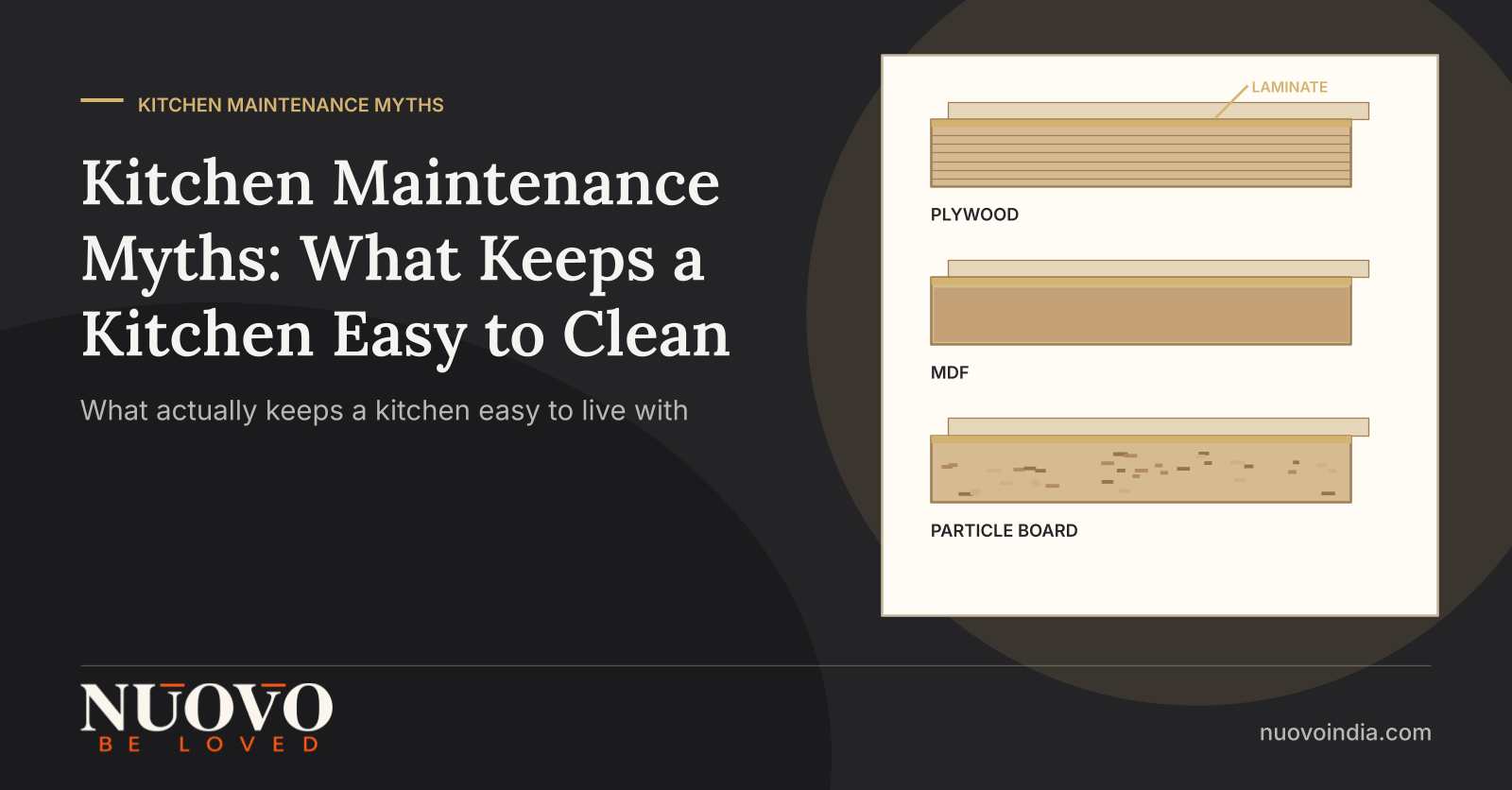
Kitchen Maintenance Myths: What Really Keeps an Indian Kitchen Easy to Clean
In urban Indian homes, only 15 percent of cooking events involved switching on a range hood, according to a 2025 study published in the Global NEST Journal. The same study found that cooking contributes roughly 26 percent of a household's daily indoor PM2.5 exposure.
That single gap explains something most homeowners blame on the wrong thing. A kitchen rarely becomes hard to maintain because the material was cheap. It usually becomes hard to maintain because grease, steam and water were never given a planned exit.
What is the short answer on low-maintenance kitchens?
A low-maintenance kitchen is the product of planning decisions, not cleaning products. The choices that genuinely reduce daily upkeep are working ventilation over the hob, matte or textured surfaces that hide smudges, fewer grout joints, properly banded and sealed panel edges at the sink and hob, and hardware that can be adjusted or replaced without dismantling the cabinet.
Finish colour matters far less than joint detailing and moisture control. In Indian homes, most maintenance complaints trace back to three causes: unmanaged cooking grease, water standing at panel edges, and hard water deposits on taps, sinks and splashbacks. Fix those three at the design stage and the kitchen largely looks after itself.
What does "low maintenance" actually mean in a kitchen or wardrobe?
Low maintenance means three separate things, and confusing them is where most buying mistakes begin. The three are routine cleaning effort, periodic servicing, and eventual repair or replacement.
- Routine cleaning effort: how long a wipe-down takes, and how visible the residue is between cleans.
- Periodic servicing: hinge adjustment, drawer realignment, filter cleaning, silicone joint renewal.
- Repair and replacement: whether a damaged shutter, a failed channel or a swollen panel can be swapped without rebuilding the run.
A surface can score well on the first and badly on the third. High-gloss acrylic wipes clean easily but is hard to match years later if one shutter is damaged. That trade-off is a maintenance decision, not an aesthetic one.
The related term worth defining is serviceability: how easily a trained person can access, adjust or replace a component without collateral damage. Serviceability is decided by carcass construction and hardware choice, long before anyone picks a colour.
Why do new kitchens start feeling high maintenance within a year?
Because upkeep is a daily time cost, and Indian households already carry a heavy one. India's Time Use Survey 2024, released by the Ministry of Statistics and Programme Implementation in February 2025 and reported by Business Today, found that women aged 15 to 59 spent about 305 minutes a day on unpaid domestic services.
Across ages six and above, the same 2024 survey recorded 289 minutes a day for females against 88 minutes for males. A kitchen that adds even ten minutes of daily wiping is therefore adding more than 60 hours a year to someone's workload.
The second pressure is scale. TechSci Research valued the India modular kitchen market at USD 6.17 billion in 2025 and projects USD 12.32 billion by 2031 at a 12.2 percent compound annual growth rate, which means a very large number of households in 2026 are buying factory-made kitchens for the first time with no reference point for how they age.
The third pressure is renovation churn. The Houzz & Home India survey fielded in 2019 found kitchens were the most renovated room, at 33 percent of projects, with a median renovation spend of ?3,00,000 and 97 percent of homeowners hiring a professional. Rooms get redone when they stop working, and maintenance fatigue is a common trigger.
Which kitchen maintenance myths cause the most regret?
The costly myths are the ones that sound like common sense. Each one below shifts attention to a decision that does not actually control upkeep, while the decision that does control it goes unmade.
|
Common myth |
What actually happens |
What to decide instead
|
|---|---|---|
|
Glossy shutters are easiest to clean |
They wipe clean quickly but show fingerprints, oil film and swirl marks between every clean |
Match sheen level to how often the surface is touched, not to showroom appeal |
|
Waterproof grade panels cannot swell |
Panels usually fail at unsealed cut edges and service cut-outs, not across the face |
Specify edge banding and sealing at the sink base, hob base and all cut-outs |
|
Expensive hardware never needs attention |
Hinges and channels still need periodic adjustment as loads settle |
Choose hardware with available spares and accessible fixing points |
|
Natural stone must be sealed every year |
Many dense stones need little or no sealing, while softer stones mark from acids regardless |
Ask which specific stone you are buying and what its real care routine is |
|
Auto-clean chimneys need no cleaning |
Oil collection and filter surfaces still need manual attention on a schedule |
Plan hood type and duct route around actual cooking volume |
|
More storage means less mess |
Deep, hard-to-reach storage accumulates items and becomes a cleaning liability |
Plan storage by access frequency, then cap total volume |
Is a glossy finish really easier to clean than a matte one?
Glossy surfaces are easier to wipe but harder to keep looking clean, and matte surfaces are the opposite. Gloss is a smooth, non-porous film, so grease lifts off readily. It is also reflective, so every fingerprint, water spot and micro-scratch reads as a defect under kitchen lighting.
Designers working with high-use kitchens tend to land in the same place. "Flat, matt slab doors are one of the easiest kitchen styles to keep clean," says Josie Medved, Design Manager at Symphony Kitchens in the United Kingdom, in designer interviews published by Rehome.
In the same set of interviews, Julie Gokce, Senior Kitchen Designer at More Kitchens in the United Kingdom, points at joints rather than surfaces: "Grout is the enemy of the low-maintenance kitchen." Both observations come from UK practice, but they transfer directly to Indian kitchens, where tiled splashbacks and heavy tempering oil are both common.
|
Finish type |
Wipe-down effort |
How visibly it holds marks |
Repair and matching
|
|---|---|---|---|
|
High-gloss acrylic or lacquer |
Low |
High, shows prints and swirls |
Difficult to colour-match later |
|
Matte laminate |
Low to moderate |
Low |
Straightforward if the decor code is recorded |
|
Textured or anti-fingerprint laminate |
Moderate in the texture grain |
Very low |
Depends on range continuity |
|
Veneer with coating |
Moderate |
Low, but coating wears at edges |
Needs recoating rather than swapping |
Does a waterproof plywood grade mean the cabinet will never swell?
No, because grade describes the panel, not the cabinet. Boiling-water-proof plywood resists moisture across its glue lines, yet the common failure point is a cut edge or a service cut-out that was never sealed or banded.
The distinction matters even more for fibre-based panels. Wikipedia's entry on medium-density fibreboard notes it is used primarily for indoor applications because of poor moisture resistance, and that low-grade board can swell when saturated.
In practice, three locations decide whether a kitchen stays dry over a decade. The sink base, where plumbing joints weep slowly, the hob base, where steam condenses, and the skirting line, where floor washing water reaches the carcass.
- Seal and band every cut edge, including holes drilled for pipes and waste.
- Keep the sink base carcass raised clear of the floor on adjustable levellers.
- Use a drip tray or removable base liner where a leak is most likely.
- Silicone the counter-to-splashback joint and plan to renew it periodically.
Do granite and quartz countertops need sealing every year?
Usually not, and the annual sealing habit is one of the most repeated pieces of misinformation in the category. The Natural Stone Institute states plainly that most granite countertops do not need to be sealed, and that where a quality sealer is used it should have a life expectancy of ten to fifteen years.
What does vary by stone is acid sensitivity. Lemon, tamarind, curd and vinegar sit on an Indian countertop daily, and softer calcareous stones mark from them whether or not a sealer has been applied.
Engineered surfaces shift the question from sealing to heat and joint care. Houzz's 2026 Kitchen Trends Study, which surveys United States homeowners, recorded engineered quartz as the most preferred slab material for slab backsplashes at 39 percent, ahead of quartzite at 33 percent.
Why does a kitchen look dirty again within hours of cleaning?
Two invisible inputs are usually responsible: water chemistry and airborne cooking residue. Where supply water is hard, limescale, a chalky deposit consisting mainly of calcium carbonate, forms on taps, sink bowls and glass as soon as droplets evaporate.
The second input is cooking aerosol. Indian cooking relies on tempering, deep frying and long simmering, which puts oil into the air, and the 2025 Global NEST Journal study cited earlier found that simple ventilation measures such as opening windows or running a range hood more than doubled the rate at which indoor PM2.5 decayed.
A kitchen hood is therefore a maintenance device as much as an air-quality device. Mesh and baffle grease filters capture oil well but require regular cleaning, while charcoal filters in ductless units cannot be cleaned and must be replaced.
- Choose a ducted hood with the shortest practical duct run where the building allows it.
- Size the hood to cover the hob fully, not to match cabinet widths.
- Specify filter types you are willing to clean at the stated interval.
- Use a wipeable splashback material behind the hob instead of a heavily grouted one.
Why do wardrobes need more maintenance than owners expect?
Because wardrobe upkeep is driven by internal planning and ventilation, not by shutter finish. A wardrobe that is too deep forces items to be stacked front to back, which means every retrieval disturbs the stack and the interior never stays ordered.
Humidity is the second factor. Wardrobes on external walls, especially in coastal and high-rainfall regions, can hold damp air against the back panel, which is where musty odour and surface mould typically begin.
The 2026 Houzz Kitchen Trends Study found that 94 percent of renovating homeowners added specialty interior storage, with pull-out bins at 64 percent and spice storage at 41 percent, which signals how much of perceived tidiness now comes from fittings rather than from box volume. The same logic applies inside a wardrobe: hanging height, drawer depth and shelf spacing decide whether it stays neat.
What should you judge a kitchen or wardrobe on if you want less upkeep?
Judge it on five things, and none of them is the finish sample in your hand. These criteria predict upkeep far better than brand names or catalogue photographs.
- Design thinking about your actual routine: whether the plan was drawn around how your household cooks, stores and cleans, or around a standard template.
- Storage planned by access frequency: whether daily items sit in the easy zone and rarely used items are deliberately capped in volume.
- Material and hardware specification in writing: whether panel grades, edge banding, finish codes and hardware models are recorded so they can be matched or serviced years later.
- Manufacturing consistency: whether panels are cut, banded and drilled to repeatable tolerances, since loose joints are where grease and water enter.
- Installation and single-point accountability: whether one party owns levelling, sealing, alignment and the eventual service call, rather than three trades blaming each other.
What should you check before approving the final design?
Run this short list before you sign off, because every item on it is cheap to fix on paper and expensive to fix after installation. Ask for answers in writing rather than verbally.
- Edge and cut-out treatment: ask exactly which edges are banded and sealed, including holes drilled for plumbing and electricals.
- Sink and hob base detailing: confirm how the carcass is protected from slow leaks and steam, and whether the base is serviceable.
- Ventilation plan: confirm hood type, duct route, hob coverage and the filter cleaning interval you are accepting.
- Hardware serviceability: confirm the model of hinges and channels and whether spares and adjustment access are available later.
- Finish and decor codes recorded: ask for the exact finish references in your file so a single damaged shutter can be matched.
- Written cleaning guidance: ask which cleaners are safe for each surface, since the wrong agent damages good material faster than use does.
Who can take a low-maintenance plan from drawing to installed kitchen?
The hard part is not knowing these principles, it is holding them through design, manufacturing and installation without compromise. Nuovo Kitchens & Wardrobes is a design-and-execution brand specialising in modular kitchens and wardrobes for residential projects, working with homeowners, architects and interior designers across new homes, renovations, apartments and villas. The practice covers thoughtful design, storage planning, materials and hardware, quality manufacturing and professional installation as one connected process rather than separate handoffs.
If you are planning a kitchen or wardrobe and want it to stay easy to live with, you can explore Nuovo's modular kitchen and wardrobe design work or discuss your kitchen or wardrobe requirements with the Nuovo team and talk through the specific maintenance decisions your home and layout call for.
Frequently asked questions
Is a matte kitchen harder to clean than a glossy one?
Matte usually takes slightly more effort per wipe but looks clean for far longer between wipes. Gloss releases grease more easily yet shows fingerprints, water spots and fine scratches under direct light. For kitchens used heavily every day, the lower visible-mark rate of matte or textured finishes tends to win on total effort.
Does a BWP or marine grade panel make a kitchen waterproof?
No. Panel grade describes the panel's resistance, not the cabinet's, and most moisture damage starts at unsealed cut edges, drilled holes and the skirting line. Ask specifically how edges and cut-outs are banded and sealed, and keep the sink base raised on levellers.
How often should a kitchen countertop be sealed?
It depends entirely on the stone, and many do not need it. The Natural Stone Institute states that most granite countertops do not need sealing, and that a quality sealer should last ten to fifteen years where one is used. Ask which specific stone you are buying and what care routine the fabricator recommends for it.
Do auto-clean chimneys remove the need for cleaning?
No. Auto-clean features manage collected oil inside the unit, but filters, baffles and the hood surface still need manual cleaning on a schedule. Charcoal filters in ductless hoods cannot be cleaned at all and must be replaced periodically.
Why does my wardrobe smell musty even though it looks clean?
Usually because humid air is trapped against the back panel with no path out, which is common on external walls in coastal and high-rainfall areas. A small ventilation gap behind the unit, a sealed back panel and avoiding packed-tight storage all help. If the panel has already absorbed moisture, the back panel itself may need attention rather than the contents.
Does more storage make a kitchen easier to maintain?
Not by itself. Storage planned by how often items are used reduces clutter, while storage added purely by volume tends to collect items in hard-to-reach places and becomes a cleaning liability. Cap total volume deliberately and put daily items in the easy reach zone.
Sources
Every third-party figure quoted above traces to one of the following sources.
- Indushri Shanmuga Sundaram, Gandhimathi and Sri Pranap, "Indoor Air Pollution from Residential Cooking: Assessing Ventilation Behaviors, PM2.5 Exposure, and Health Implications in Urban Indian Homes", Global NEST Journal, Vol. 27, Issue 10, 2025
- Business Today, "Time Use Survey: Women take on most of household and caregiving work", 25 February 2025, reporting India's Time Use Survey 2024 by the Ministry of Statistics and Programme Implementation
- TechSci Research, "India Modular Kitchen Market to Grow with a CAGR of 12.2% through 2031", 2025
- Architect and Interiors India, "Houzz India survey reveals top home renovation trends", reporting the Houzz & Home India survey fielded in 2019
- Houzz, 2026 Houzz Kitchen Trends Study, United States
- Natural Stone Institute, "Sealing Natural Stone Countertops"
- Rehome, "Low-Maintenance Kitchens: Designers Share the Easiest Materials and Finishes to Live With"
-
How good quality furniture can improve overall efficiency

-
Increase productivity with use of good quality office furniture.

-
Your Comfort is our first priority.

-
Benefits of modular kitchen

-
Advantages of Modular Kitchens over traditional Kitchens

-
10 Tips for Planning the Perfect Modular Kitchen

-
How to Choose the Right Office Chair for Your Needs

-
How to Care for and Maintain Your Modular Kitchen

-
The Role of Color in Office Furniture

-
How do you set a table for dinner?

-
Kitchen Pricing Breakdown

-
How to Verify a Kitchen or Wardrobe Company's Real Work Before You Pay an Advance

-
Modular vs Carpenter Made Kitchens: Which Common Beliefs Actually Hold Up in 2026?

-
How Families Can Agree on a Kitchen or Wardrobe Without Months of Back and Forth

-
Kitchen Pricing Myths That Quietly Cost Indian Homeowners Money

-
Kitchen Workflow Myths: Why a New Kitchen Can Still Feel Tiring to Cook In

-
Kitchen and Wardrobe Design Myths That Quietly Date Your Home

-
Hardware Myths That Quietly Shorten the Life of Indian Kitchens and Wardrobes

-
Kitchen Execution Myths: Why Projects Stall After the Design Is Approved

-
7 Vendor Myths That Decide Whether Your Modular Kitchen Turns Out Well